



For Broadcasters: Sports Betting Revenue and Regulatory Reform Don’t Have to Be at Odds
The intent is there. The conversion isn’t.
Sports betting is a speed business. A viewer watching live sport is a high-intent customer, and every operator is spending heavily to acquire exactly that customer. Perhaps the biggest opportunity to increase customer value is in reducing friction in the gap between a viewer deciding they want to bet and actually getting the bet placed.
Where the gap actually happens
A viewer sees a moment: a substitution, a shift in momentum, a scoring chance. The instinct to act is immediate. Acting on it today means leaving the broadcast, whether that’s opening a separate app and finding the right market, or in markets like Australia, picking up the phone and calling the operator directly, since in-play bets there can’t be placed in-app. The exact mechanics differ by market, but the pattern doesn’t: the decision happens on the broadcast, and the action happens somewhere else, with the moment often gone by the time it does.
That gap is where operators lose a customer they already paid to acquire, and where broadcasters lose a commercial relationship that belongs to them. The attention, the context, and the emotional trigger all happen on the broadcast. The transaction doesn’t.

Closing it without building a betting product
The fix isn’t a betting app. It’s removing the search and the friction between what’s on screen and whatever step comes next for the viewer, whether that’s an in-app bet slip or the right operator on the other end of a call. With sync in place, the right event, market, and odds are already surfaced the moment the viewer picks up their phone. No searching for what to bet on, even where the final step still has to happen somewhere else.
That’s not a product feature for the operator, it’s a conversion rate transformation for a customer they’re already carrying the cost of acquiring. And because it runs broadcaster-side, deployed silently alongside the existing feed, there’s no new app for the viewer to download and no habit to relearn.
Why the Canadian market matters right now
Canada is one of the clearest examples of why timing matters here. Single-event betting was legalised in 2021 and the market hasn’t slowed since, hitting an estimated USD $4.1B in gross gaming revenue in 2024. Ontario alone now has 48 licensed operators competing for the same viewers, and Alberta opens its own regulated market on July 13, with more than 30 operators already lining up to enter. That’s an open, competitive, fast-growing environment where the operator who reduces friction between intent and conversion first has a real advantage, not a theoretical one.
Ontario is also worth watching for a second reason. A bill currently before the provincial legislature would restrict gambling advertising in the province, arriving at a moment when the market is setting handle records almost every month. It hasn’t passed yet, but it’s a signal that the advertising conversation playing out in Australia isn’t unique to one market. Regulators everywhere are converging on the same question: how much gambling promotion should reach a shared broadcast audience, versus an audience that’s already opted in. iGaming Ontario’s own research points to why that distinction matters. Independent research commissioned by the regulator found that only around 9% of Ontario players were still gambling exclusively on unregulated sites in 2026, down from roughly double that a year earlier, evidence that a well-built regulated channel with real player protections earns trust rather than pushing players elsewhere.
There’s a compliance angle too. A sync layer that operates inside the wagering app itself, rather than as broadcast-side advertising, sits outside the kind of gambling ad restrictions increasingly being introduced across markets, while still satisfying player verification frameworks operators already have to meet. That matters more every year, not less.
A market too large to leave unaddressed
Zoom out and the numbers make the case on their own. The US wagering market hit a record USD $13.7B in 2024, with live betting now accounting for roughly half of mature markets and over 80% of wagers placed via mobile. Globally, the market sits around USD $114B and is growing at roughly 11% a year through 2032.

Why Australia is the clearest example of all
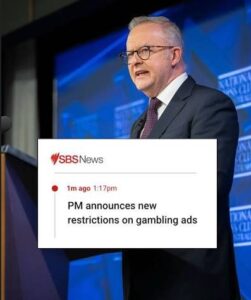
Australia is where this dynamic is most visible. The market is significant on its own, around AUD $2.2B in GGR across 230-plus licensed bookmakers, but it’s heading into a ban on gambling advertising during live sport broadcasts from January 2027, alongside a cap of three gambling ads per hour outside those windows. For operators, that closes off the channel that’s historically driven the fastest path from viewer to bettor: the on-screen prompt during the broadcast itself. The scale of that channel today is worth noting. Regulator data shows gambling ads have been running at close to three per ad break during NRL and AFL broadcasts, and the government’s own estimate is that the reforms will cut gambling ad exposure for Australians under 25 by around 80%.
It’s worth being clear about why that reform exists. Children watching sport with family shouldn’t be absorbing a constant stream of betting prompts during the broadcast, and viewers already struggling with problem gambling shouldn’t have that struggle triggered by an ad appearing mid-match, in their own living room, with no way to opt out of seeing it. That’s a reasonable position, and it’s one operators themselves have largely accepted rather than fought outright. Responsible Wagering Australia, the industry’s own peak body, has publicly acknowledged that ad volumes had climbed too high and pointed to steps the sector had already taken to pull them back, even while pushing for a more consultative process on the detail. That’s a useful marker: this isn’t an industry claiming the problem doesn’t exist, it’s one negotiating over where the line should sit, while still representing a sector that contributes billions to the Australian economy and tens of thousands of jobs.
That’s precisely the problem allt.tv’s silent connection solves, and it’s worth being precise about why. There’s no on-screen ad, no broadcast-facing prompt, no visible call to action layered over the game for every viewer to see, regardless of age or vulnerability. The connection happens device-to-device, and any interaction only happens inside a wagering app the viewer has already installed, already verified their age with, and already completed any self-exclusion steps on. It doesn’t reach a child watching the game. It doesn’t reach someone who has actively excluded themselves from betting products. It only ever reaches an adult who has already opted in to that operator’s platform and been through that operator’s own protections.
That’s not a way around the intent of the reform, it’s an approach built around the same intent: keep gambling promotion out of shared, broadcast-facing spaces where anyone watching is exposed to it, and keep it inside the verified, opted-in environments where an operator already knows who they’re talking to. The reform is about where the exposure happens, not about whether an adult who has already gone through verification can find their own way to a market they were already looking for.
That makes it not just compliant with the reform, but aligned with the reasoning behind it. Operators lose their loudest acquisition channel in January 2027. The ones who’ve already built the quiet one, working inside the protections rather than around them, won’t have noticed the change.
The architecture behind this kind of sync layer is jurisdiction-agnostic by design. The same silent connection that works in Sydney works in Toronto, London, or Chicago, adaptable to different regulatory environments without requiring a different build for each one.
The opportunity for broadcasters
Wagering operators are already spending heavily to acquire the exact viewer sitting in front of a broadcaster’s content. The broadcaster’s role isn’t to become a betting operator, it’s to own the infrastructure that makes that spend convert more efficiently, and to be part of the value that creates rather than a bystander to it.
The broadcasters best placed to benefit will be the ones with the sync infrastructure already in place before this becomes standard, not the ones starting from zero once it does.
~~~
Where allt.tv fits in
This is the exact problem allt was built to solve. Our sync technology links a viewer’s mobile device to what’s on their TV in real time, deployed broadcaster-side via SDK integration, with no app download and no change in viewer behaviour required. It’s already been integrated with a major Australian broadcast platform, and the underlying approach is protected by a granted US patent.
The commercial layer built on top of that sync connection already spans retail media, affiliate commerce, and the wagering-specific approach outlined above. The architecture is jurisdiction-agnostic by design, built to sit inside different regulatory environments rather than requiring a different build for each one.
If any of this is relevant to where your platform is headed, particularly around player acquisition efficiency or navigating advertising restrictions without losing your fastest conversion channel, it’s worth a conversation.
james@allt.tv