Maximise Live Sports ROI by Monetising the Second Screen
· James Forster [CEO, allt.tv]
Every broadcaster can tell you how engaged their audience is. Fewer can tell you what that engagement is worth.
Second screen behaviour has been treated as a measurement problem for years. Track it, report it, use it to sell ad packages. That’s the old model. The opportunity in front of broadcasters now is different: turn the moment a viewer picks up their phone during a match into a direct commercial transaction, without asking them to change a single habit.

The gap in the current model
A viewer watching a game already reaches for their phone constantly, and the scale of that behaviour is well documented. Around 88% of Americans use a second screen while watching TV, and for sports specifically the number is even more concentrated: 49% of football viewers use two or more screens at once, and 69% pick up a second screen after seeing something on air to find more information. During major live events, that behaviour tips into commerce outright. Research from a recent World Cup showed nearly a third of fans actively purchasing during live matches, with a further 26% browsing offers tied to the tournament.
Right now, almost all of that value flows to whoever owns the phone screen, not whoever owns the broadcast. Google, social platforms, and retailers themselves capture the intent that the broadcast created.
That’s the gap. The broadcaster does the hard work of holding attention. Somebody else monetises the moment attention turns into action.

Retail media and affiliate commerce as the fix
Retail media and affiliate commerce give broadcasters a way to capture that value instead of leaking it, and both are already among the fastest-growing categories in advertising and commerce. Global retail media spend hit roughly $184 billion in 2025 and is on track to pass $300 billion by 2030, growing faster than search or social. Affiliate marketing is smaller but growing at a similar clip, with the global market on track to pass $20 billion in 2026 at close to 15% annual growth, and businesses seeing an average return of $6.50 for every dollar spent.
Retail media puts relevant, contextual product placement in front of a viewer while their attention is highest, during the broadcast itself. Affiliate commerce lets a broadcaster earn a commission when that attention converts into a purchase, whether that’s a jersey, tickets, or a subscription.
Neither of these is a new category. What’s new is the ability to connect them directly to what’s happening on screen, in real time, without building a companion app and hoping viewers download it.
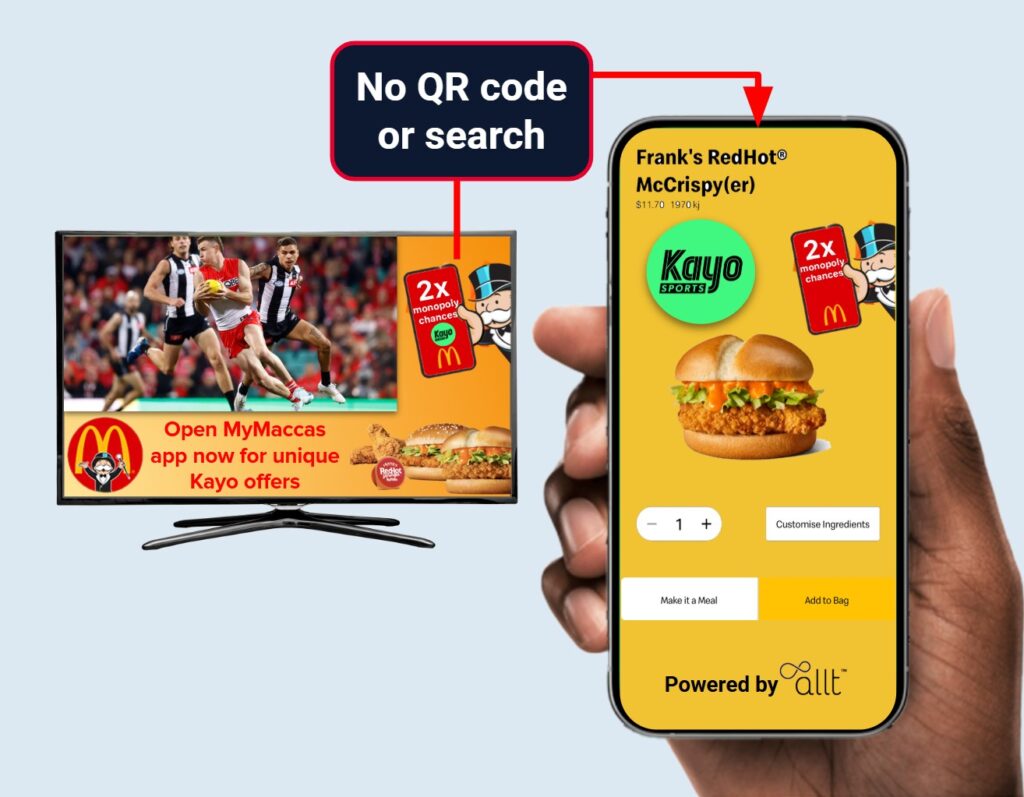
Squeezeback/L-bar ad example using allt sync
Where sync technology fits
This is the piece that’s been missing. Allt’s sync technology links a viewer’s mobile device to what they’re watching on TV in real time, deployed broadcaster-side via SDK integration. No app download. No change in viewer behaviour. The broadcaster already has the infrastructure; Allt sits inside it.
That link is what makes retail media and affiliate commerce practical at scale rather than a manual, campaign-by-campaign effort. When the platform knows what’s on screen at any given second, contextual commerce stops being a guess and becomes a real-time trigger.
Proof in the partnerships
This isn’t theoretical. Allt’s relationships with Rakuten Advertising and Impact.com exist specifically to connect that in-broadcast moment to affiliate and retail media infrastructure that already has scale and existing retailer relationships. The technology handles the sync. The commercial partners handle the transaction. The broadcaster captures a revenue line that previously went to someone else entirely.

The bigger shift
Advertising revenue across broadcast has been under pressure for years, and that pressure isn’t easing. Linear TV ad revenue is forecast to fall from around $55 billion in 2025 to under $52 billion in 2026, and under $48 billion the year after, a decline that’s expected to continue as budgets keep shifting toward streaming and connected TV. Retail media and affiliate commerce represent a genuinely new line, not a reshuffling of the existing ad pie, and one of the few growing faster than the channel it’s replacing. For broadcasters evaluating where the next few points of revenue growth actually come from, the answer increasingly sits in the second screen moment they already own but haven’t yet monetised.
The infrastructure to capture it exists today, and it doesn’t require rebuilding how your audience watches.
Worth a conversation
If you’re evaluating where the next few points of ad revenue growth come from, and want to see how this works on your own platform, it’s worth a conversation.
james@allt.tv